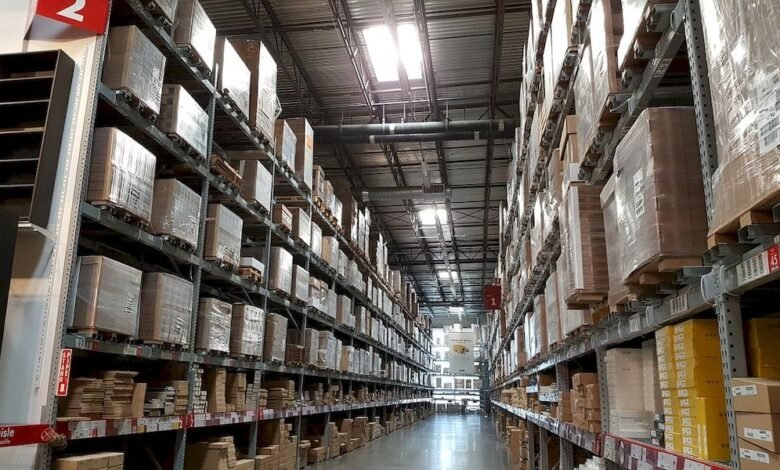
Warehouse performance depends heavily on the layout of storage systems, the movement of materials and the interaction between workers, forklifts and stock. While technology and automation receive much attention, the physical structure of a warehouse remains one of the most important foundations of operational efficiency. Racking geometry, aisle width, beam height and pallet configuration determine how quickly orders can be picked, how safely forklifts can manoeuvre and how easily a warehouse can scale with growing demand.
A well planned layout reduces congestion, limits travel distance and increases storage density without compromising access to inventory. This is where effective pallet racking design becomes a strategic tool rather than a background detail.

Why Racking Geometry Matters
Racking geometry shapes how goods move through a warehouse. The depth, width and height of each bay influence storage density and accessibility. Operators must consider pallet dimensions, SKU velocity and weight distribution before committing to a configuration. Even small variations in rack depth or beam height can change the number of pallets stored per bay or the time required for a forklift to retrieve them.
Good geometry also improves safety. Consistent spacing reduces the risk of overhanging pallets, while clear line-of-sight paths reduce collisions. Many warehouses refine their geometry during peak seasons to improve flow across high-volume areas.
Aisle Width and Forklift Flow
Aisle width is a critical factor in throughput. Wider aisles allow faster manoeuvring, smoother turns and fewer bottlenecks. They are ideal for high-volume picking environments. Narrow aisles increase storage density but require specialised equipment such as turret trucks or articulated forklifts.
Three broad aisle categories guide warehouse planning:
- Wide aisles: Suited to counterbalance forklifts and high-traffic routes.
- Narrow aisles: Increase storage density while maintaining reasonable pick times.
- Very narrow aisles: Designed for maximum density using rail guidance or wire guidance systems.
Matching aisle width to equipment type prevents inefficient backtracking and reduces damage to racking and pallets. Flow improves when forklifts follow predictable one-way paths, with clear entry and exit points.
Beam Height and Vertical Storage
Vertical space is an important yet often underused resource. Beam height determines how many pallet levels can be stacked without exceeding forklift reach limits or compromising stability. Warehouses track pallet weight, load centre and rack capacity to set safe beam intervals.
Optimising vertical storage means balancing density with accessibility. Lower beams support fast-moving SKUs, while higher levels store slow-moving or seasonal stock. Modern rack systems allow beam adjustments as inventory profiles change, helping maintain long-term layout flexibility.
Pallet Configuration and Slotting Strategy
Pallet configuration affects picking speed and replenishment frequency. Standard patterns include single-deep, double-deep and multi-pallet lanes. Slotting strategy places the fastest-moving items in the most accessible locations to minimise operator travel.
Factors influencing configuration include:
- SKU velocity
- Packaging dimensions
- Weight distribution
- Frequency of restocking
- Pick method (manual, forklift, automated)
Consistent pallet orientation and clear labelling improve accuracy and reduce picking errors.
Selective Racking: Accessible and Versatile
Selective racking is the most common warehouse layout because it provides direct access to every pallet. Forklifts can reach any location without moving other loads, which improves picking accuracy and reduces handling time.
This layout suits operations with a large number of SKUs and varying demand levels. It also works well for warehouses needing fast changeovers, as beams and uprights can be rearranged easily. However, selective racking offers lower storage density compared with deeper lane systems.
Double-Deep Racking: Higher Density with Moderate Access
Double-deep racking increases storage density by placing one pallet behind another. Forklifts with telescopic forks retrieve the rear pallet when required. This configuration is ideal for medium-turnover SKUs where access speed is less critical.
The trade-off is reduced selectivity, as front pallets must be moved to reach the rear. For many operators, the increase in density offsets the occasional extra handling. As part of a broader Pallet Racking Design, double-deep systems allow strategic placement of medium-velocity goods.
Drive-In Racking: Maximum Density, FIFO Challenges
Drive-in racking creates deep lanes where forklifts enter the structure to place and retrieve pallets. It offers very high storage density and suits operations with large volumes of uniform products.
The layout follows a Last-In, First-Out pattern, which limits its use for date-sensitive goods. Forklift skill is essential because operators must navigate inside the rack. Drive-in systems work best for seasonal surges, cold storage and production batches with high uniformity.
Push-Back Racking: Efficient Use of Space
Push-back racking stores pallets on nested carts that roll on inclined rails. When a pallet is added, it pushes the previous one backward. When removed, the remaining pallets roll forward automatically.
This layout offers higher density than selective racking and better accessibility than drive-in systems. It supports a Last-In, First-Out flow but allows multiple SKUs per aisle. Push-back is frequently chosen for warehouses needing both space efficiency and reliable rotation.
Pick Accuracy and Flow Through the Warehouse
Racking layout affects pick paths as much as storage density. Straight, predictable routes reduce operator fatigue and make training faster. Grouping SKUs by velocity ensures fast-moving items stay in high-access zones.
Good layout also supports barcode scanning, RFID systems and warehouse management software. When racks align with technology, accuracy improves without slowing down the picking process.
Scalability and Long-Term Planning
Warehouses evolve as order volumes rise, SKU counts expand and equipment changes. Scalable pallet racking design considers future beam adjustments, aisle reconfigurations and potential upgrades to automation.
Scalability includes:
- space for mezzanines
- ability to convert selective racks into deeper systems
- capacity for AGVs or automated shuttles
- modular components for seasonal expansion
Planning for growth prevents costly retrofits and minimises disruption during layout changes.
Conclusion
Warehouse efficiency begins with thoughtful racking design. Geometry, aisle width, beam height and pallet configuration all influence speed, safety and storage density. By choosing the right blend of selective, double-deep, drive-in or push-back systems, operators can improve pick accuracy, enhance forklift movement and prepare for long-term scalability.